
The Professions of Digital Economy
HSE Institute for Statistical Studies and Economics of Knowledge presents the data concerning the employment in professions which are connected with the intensive use of ICT. The estimates are based on the OECD methodology.
Indicators of Innovation in the Russian Federation : 2018
This data book presents the results of statistical surveys characterising innovation processes in the economy of the country. It shows the dynamics of consolidated indicators, produced in accordance with modern international standards of the Organisation for Economic Co-operation and Development (OECD) and Eurostat, showing the level of development of technological and non-technological innovation.
Foresight and STI Governance no 2, 2019
The new issue of the Foresight and STI Governance journal is devoted to the impact of technological progress on employment prospects and the development of competencies. This problem is viewed from the perspective of employees, companies and regions.
Graduation party of the Master’s Programme ‘Governance of Science, Technology and Innovation’
On 28 June, 2019 a graduation ceremony of the ISSEK Master’s Programme ‘Governance of Science, Technology and Innovation’ took place at the Higher School of Economics.
The SPIEF Trail: a Triad of Partnership Agreements
During the St. Petersburg International Economic Forum the Higher School of Economics signed cooperation agreements with a number of organisations. ISSEK staff — members of the S&T Foresight Centre and the Competence Centre for Cooperation with International Organisations actively participated in completing the groundwork for three of them: with the Eurasian Economic Commission (EEC), the Eurasian Development Bank (EDB), and the Rosselkhozbank.
Synchronising Russian and Chinese Foresight Studies
Alexander Sokolov, Director of the Foresight Centre and Deputy Director of the HSE ISSEK, visited Shanghai (PRC) in early May to take part in the International Pujiang Innovation Forum. The forum is annually hosted by the PRC Ministry of Science and Technology jointly with the Shanghai Municipal Government to discuss and coordinate decisions in the science, technology, and innovation policy area. This year the participants shared their expectations about the period until 2035.
Evgeniy Kutsenko: 'Smart Regions Can Only Exist in a Unified System of Coordinates'
Evgeniy Kutsenko, Head of the HSE ISSEK Russian Cluster Observatory, shares on his Facebook page his impressions of taking part in the Regional Studies Association conference in Santiago de Compostela (Spain) which took place on 5-7 June, 2019, mentioning particularly interesting topics and presentations.
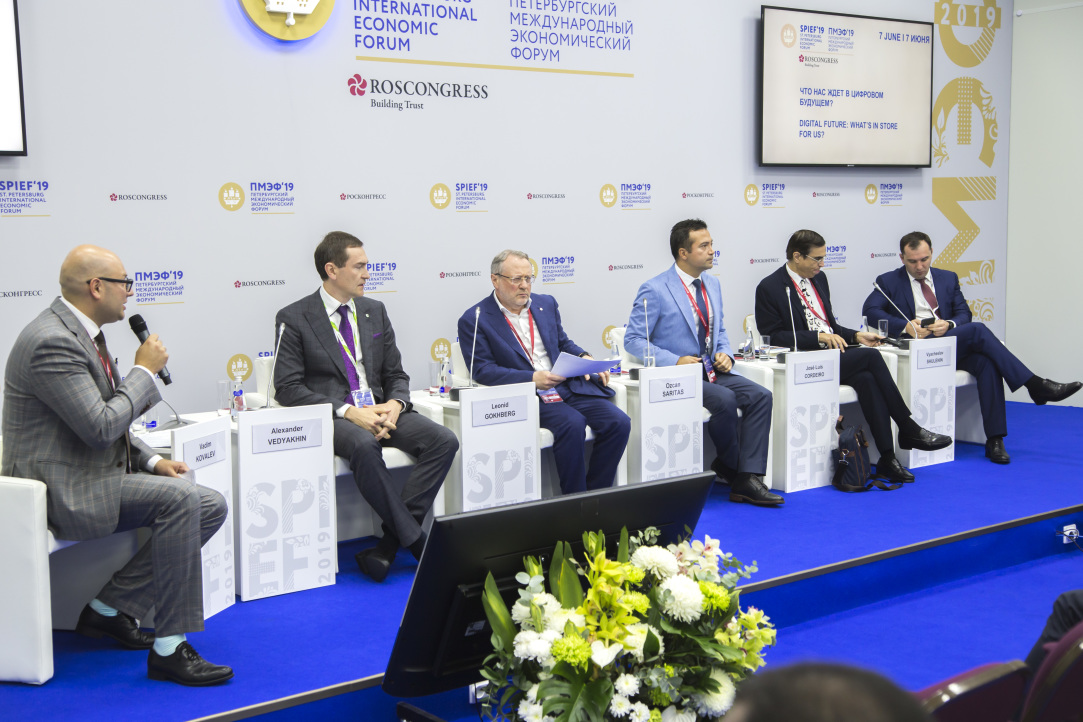
Digital Inequality a Key Challenge on the Road to the Digital Future
Along with personal computers, the digital economy originated in the 1980s and quickly began to evolve, with information and technology becoming a bigger and bigger determinant of a country’s economic growth. A new stage of this evolution is now upon us, with explosive technology and data transformation now becoming one of the decisive factors of production.
Internal Expenditures on Digital Economy Development
The HSE Institute for Statistical Studies and Economics of Knowledge presents results of the pilot calculation of internal expenditures on digital economy development, based on data collected in the course of federal statistical observations and by the Bank of Russia. According to the HSE ISSEK estimates, in 2017 internal expenditures on digital economy development amounted to approximately 3.3 trillion roubles, or 3.6% of GDP.
Data is Turning into Cities’ Circulatory System
On 27 May, 2019 Steven Griffiths, Senior Vice President for Research and Development at Khalifa University of Science and Technology (UAE), and member of the International Award Committee of the Global Energy Prize, delivered an open lecture at the Higher School of Economics.