
Evgeniy Kutsenko: 'Smart Regions Can Only Exist in a Unified System of Coordinates'
Evgeniy Kutsenko, Head of the HSE ISSEK Russian Cluster Observatory, shares on his Facebook page his impressions of taking part in the Regional Studies Association conference in Santiago de Compostela (Spain) which took place on 5-7 June, 2019, mentioning particularly interesting topics and presentations.
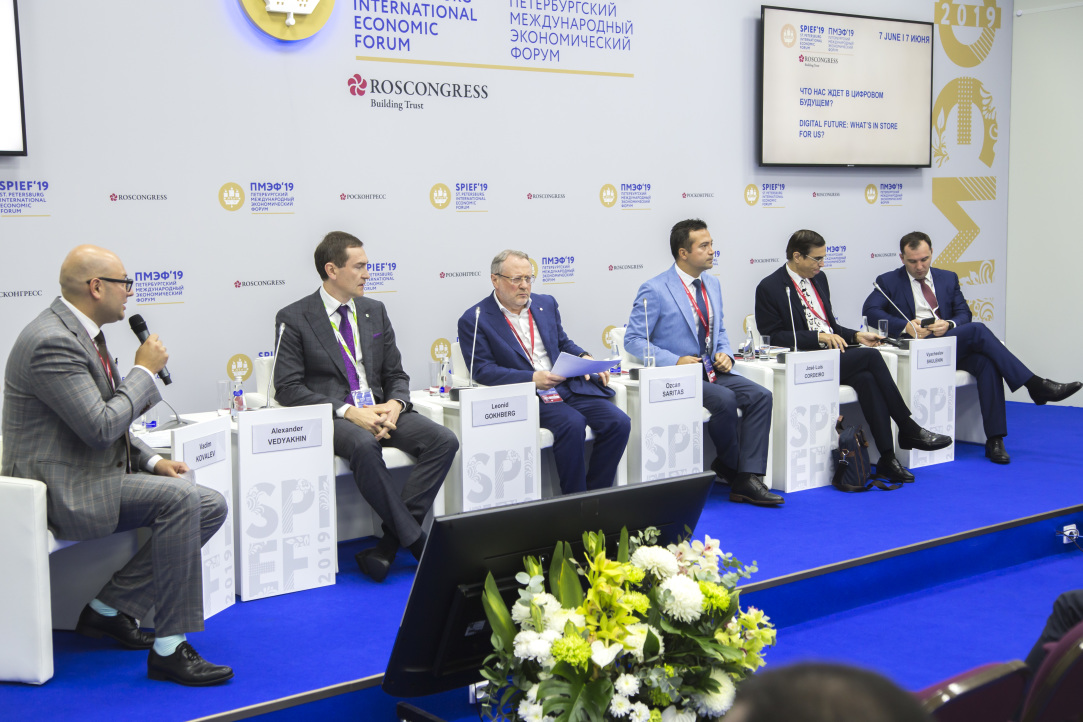
Digital Inequality a Key Challenge on the Road to the Digital Future
Along with personal computers, the digital economy originated in the 1980s and quickly began to evolve, with information and technology becoming a bigger and bigger determinant of a country’s economic growth. A new stage of this evolution is now upon us, with explosive technology and data transformation now becoming one of the decisive factors of production.
Internal Expenditures on Digital Economy Development
The HSE Institute for Statistical Studies and Economics of Knowledge presents results of the pilot calculation of internal expenditures on digital economy development, based on data collected in the course of federal statistical observations and by the Bank of Russia. According to the HSE ISSEK estimates, in 2017 internal expenditures on digital economy development amounted to approximately 3.3 trillion roubles, or 3.6% of GDP.
Data is Turning into Cities’ Circulatory System
On 27 May, 2019 Steven Griffiths, Senior Vice President for Research and Development at Khalifa University of Science and Technology (UAE), and member of the International Award Committee of the Global Energy Prize, delivered an open lecture at the Higher School of Economics.
Figure of the Day: 85%
of Russians believe the current rate of S&T development is excessively high.
HSE ISSEK Researchers Sign Cooperation Agreement with Korean Colleagues
This May, HSE and the Science and Technology Policy Institute (STEPI, Republic of Korea) signed a cooperation agreement on science and advanced technology research. This agreement was signed by Leonid Gokhberg, HSE First Vice Rector, Director of the Institute for Statistical Studies and Economics of Knowledge, and Dr. Hwang-Hee Cho, STEPI President.
Checklist for Those Who’d Like to Govern Science
Following the Open Doors Day of the ISSEK Master’s Programme ‘Governance of Science, Technology and Innovation’ we’ve summarised the most important aspects of the feedback received from managers, teachers, and partners. This can serve as a kind of checklist for those who are considering a career in science, and are willing to lead advanced research and development activities.
A Common Strategic Approach to the EAEU S&T Development is in Order
On 12 April, 2019, in the scope of the 'Foresight and STI Policy' symposium (part of the HSE XX April International Academic Conference on Economic and Social Development) a series of events were held to discuss STI cooperation in the Eurasian Economic Union (EAEU).
‘Statistics Should Be Available and Comprehensible to Everyone’
Implementing a digital analytical platform, opportunities for Big Data, and other prospects for the development of Russian statistics were discussed by participants at a plenary session of the XX April International Academic Conference.
‘Isolationism Is the Pathway to Technological Degradation’
The XX April International Academic Conference continued on April 11 with a discussion on digitalization of the economy and public administration. Maxim Akimov, Deputy Prime Minister of Russia and Curator of the Digital Economy National Programme, spoke about digital business models, public administration, digitalization in industry and science, and the impact of digital technology on the job market.