
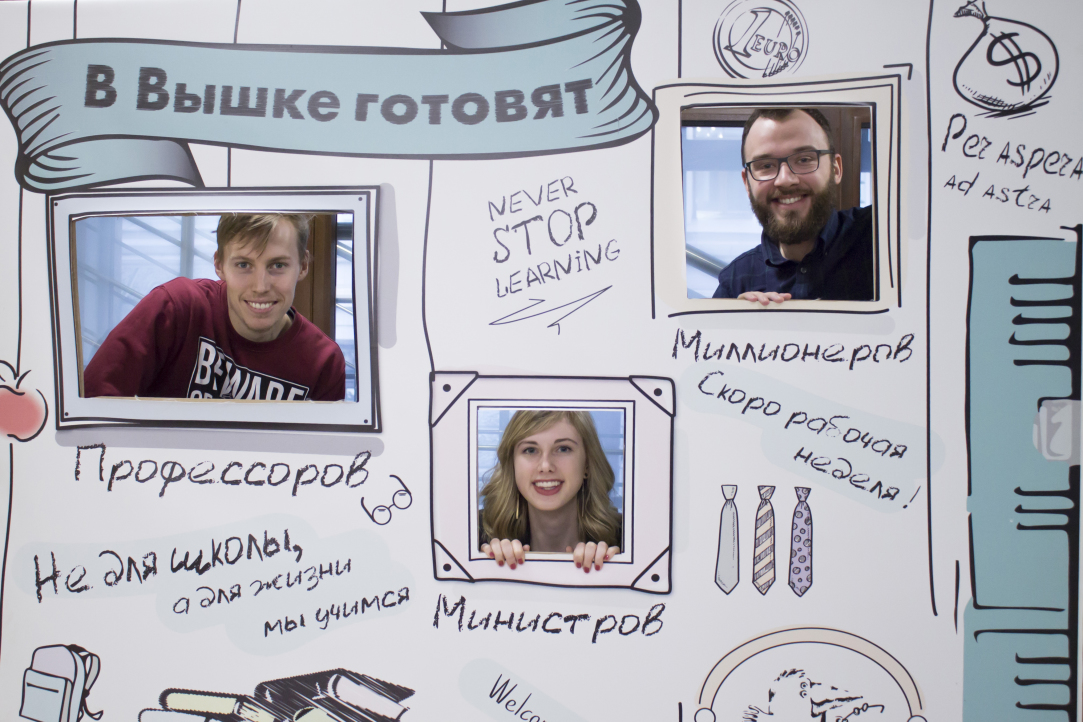
‘I Chose the Programme for Its Flexibility’
Master’s programme in Governance of Science, Technology, and Innovation has been offered by HSE ISSEK since 2014. It helps students acquire knowledge about science, technology and innovation management and policy. Below, Dirk Meissner, Academic Supervisor of the programme, talks about its key features and development. Besides, first and second-year international students describe their reasons for enrolling in the programme and share their experience of studying at HSE.
Russian Authorities Oppose University
"Curie", a Swedish web magazine devoted to the world of research, refers to the data book “Science, Technology and Innovations: 2017” published by the HSE Institute for Statistical Studies and Economics of Knowledge. David Isaksson, the author of the article, examines the Russian research field by visiting the European University of Saint Petersburg, talking with foreign scientists in Russia and reflecting on freedom of expression in Russian universities.
ISSEK in 2017
In the building on Myasnitskaya Street (number 11) almost 200 employees of the Institute for Statistical Studies and Economics of Knowledge have spent 247 working days, or 1976 working hours, or 118,560 working minutes. The 2017 year was a threefold milestone: Higher School of Economics turned 25, HSE ISSEK turned 15, Foresight and STI Governance journal turned 10. Lots of challenges and achievements marked this triple anniversary.
Foresight and STI Governance no 4, 2017
The special issue of the Foresight and STI Governance journal various aspects of labour market in the context of technological transformations are being considered.
"Research and Innovation Must be the Driving Force of Our Future Relationship"
On December 18, Bruno Le Maire, French Minister for the Economy and Finance, delivered an open lecture at HSE. In his speech, the Minister discussed the prospects for cooperation in the field of science, technology and innovation between Russia and France.
How Science is Managed in Russia
The HSE Institute for Statistical Studies and Economics of Knowledge conducted a study of best management practices in the science and technology area. The results, and a proposal to set up an online platform for monitoring such practices, were presented at a round table discussion hosted by HSE.
«Sand box» for Innovators
The ability to analyse trends is one of the key skills for those who are going to make management decisions in the field of science, technology and innovation. The students of HSE perfect it, studying theory, examining tools and cases. But it is known that knowledge and skills are much better learnt when resonating with the realities of life or with a relevant information agenda. Educational experience is shared by Dmitry Baryakin, a graduate of the master's programme of the ISSEK (HSE).
Rehabilitation Industry Gets Basic Strategy
The RF Government approved “Development Strategy for Rehabilitation Products Industry Until 2025” (Regulation N2599-r of 22 November, 2017), and a set of measures to promote development of advanced rehabilitation products industry in 2017-2019. Both documents were drafted with active participation of HSE ISSEK experts.
Cluster Policy and Industrial Development at the Focus of TCI 2017 Global Conference Discussions
The 20th (anniversary) conference of the Association of Cluster Practitioners and Experts (TCI Network) is over; Russia was represented by Evgeny Kutsenko, Head of the HSE ISSEK Russian Cluster Observatory. He shares his observations, and exchanges with advanced designers and practitioners of industrial and cluster policies.
Clusters as Drivers of Smart International Collaboration: European Experience
300 participants from 25 European countries took part in a joint effort to design the image of future clusters in the scope of the 2nd GROW your REGIOn conference in Valencia. Ekaterina Islankina, Researcher at the HSE ISSEK Russian Cluster Observatory, studied European experience and told the colleagues about Russian cluster initiatives, support programmes, and approaches to promoting smart specialisation in Russian regions.